Our PSHE intent
Intent
This section sets out the overarching curriculum plan, structure and sequence, and the knowledge and skills pupils will develop.
What is PSHE & RSE?
PSHE stands for Personal, Social, Health and Economic Education. RSE stands for Relationships and Sex Education. Schools may use different names for these subjects: RSE may be referred to as RSHE when health education is included; similarly, PSHE may be referred to as PSHCE when citizenship is included.
The Kapow Primary RSE & PSHE scheme covers the full breadth of learning pupils need to stay healthy, safe and prepared for life. This includes:
- Personal.
- Social.
- Health.
- Economic.
- Relationships.
- Citizenship.
- Sex education (optional).
Relationships and health education statutory guidance
The new RSE & PSHE scheme for Years 1-6 has been rewritten to meet the 2025 Relationships and sex education (RSE) and health education statutory guidance, which schools must follow from September 2026.
This is not just an update to the previous scheme but a thorough redevelopment to ensure every element meets the expectations set out in the new guidance. The Reception units will be refreshed but will remain broadly the same, continuing to fulfil the statutory requirements of the Early Years Foundation Stage Framework.
To see where the statutory guidance is met across the scheme, refer to our Statutory guidance coverage document. For individual units, use the curriculum portal and click on the relevant unit to see which statutory statements it targets.
Additional guidance
RSE & PSHE is the subject that most directly supports pupils’ personal development. As a result, a wide range of statutory and non-statutory guidance informs best practices. Subject and school leaders may want to consider how their RSE & PSHE curriculum supports them in meeting the following:
Statutory guidance
- Relationships and sex education (RSE) and health education statutory guidance.
- The Equality Act 2010, including duties relating to protected characteristics.
- Keeping children safe in education.
Non-statutory guidance and frameworks
- Teaching online safety in schools.
- Promoting fundamental British values through SMSC.
- Citizenship programmes of study: Key stages 1 and 2 (non-statutory).
Together, these documents outline the expectations for helping pupils stay safe, understand themselves and others, develop healthy relationships and become responsible members of their school and wider community.
In addition to this guidance, Ofsted considers how well schools support pupils’ personal development. Inspectors assess how the curriculum promotes wellbeing, healthy relationships, online safety, citizenship and pupils’ wider personal development.
While Ofsted does not issue subject-specific guidance for RSE & PSHE in the same way it does for many other subjects, such as through published research reviews, the personal development and wellbeing sections of the school inspection toolkits set out the standards schools are expected to meet.
Kapow Primary’s scheme ensures that statutory RSE & PSHE content is taught in full, supporting the wider work schools do across the curriculum to develop pupils’ personal development. It also takes into account the statutory and non-statutory guidance outlined above, with mapping documents provided to show how this guidance is covered across the scheme.
To see where the RSHE and EYFS statutory guidance is met across the scheme, refer to our Statutory guidance coverage document.
To see how the Kapow Primary RSE and PSHE scheme supports pupils’ personal development, including their spiritual, moral, social and cultural development and understanding of British values, refer to British values, SMSC, PD and Protected characteristics mapping.
Citizenship
Citizenship education is currently non-statutory in primary schools, although there is a recommended Programme of study that schools can choose to implement.
However, the recent Curriculum and assessment review final report recommends that citizenship should be added to the National curriculum in the next iteration due in 2028. The Government have accepted the recommendation.
Kapow Primary’s RSE & PSHE curriculum already includes citizenship lessons (including financial literacy) and will be updated to meet the new guidance released in 2027.
Strands and key areas
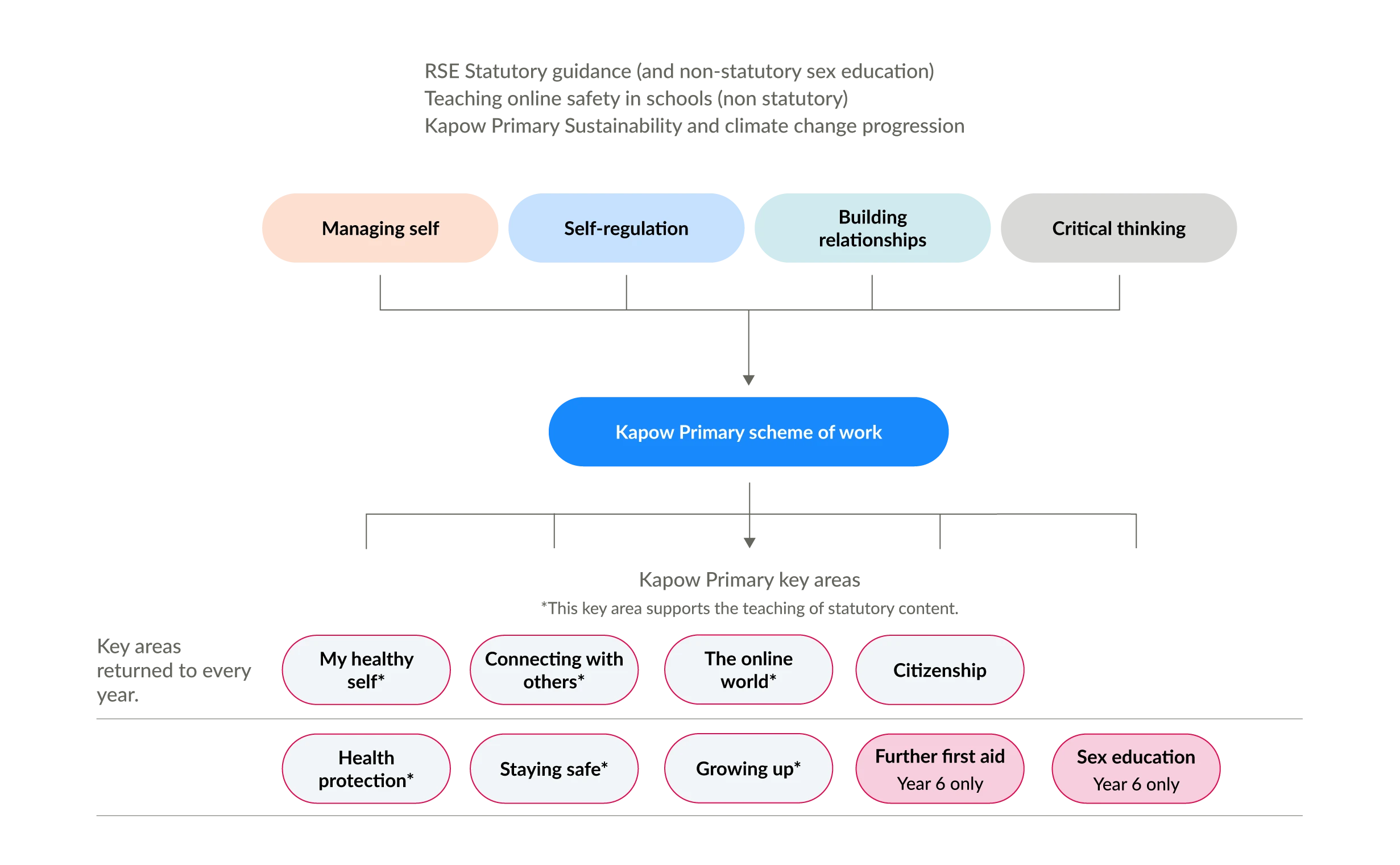
The scheme is organised into strands and key areas to ensure a broad and balanced curriculum.
Key areas group learning into meaningful themes and ensure that all statutory content is covered. The strands weave throughout all units, demonstrating how pupils develop lifelong skills in managing themselves, regulating their emotions, building positive relationships and thinking critically.
Together, the strands and key areas help pupils revisit important ideas over time, building their confidence and understanding in a structured way.
Key areas
Some key areas are revisited each year, while others are revisited less frequently to reflect the volume of content in the statutory guidance and ensure learning is age-appropriate.
In Year 6, teachers can choose between the First aid unit or the Sex education unit, both of which are non-statutory and build on previous learning.
Visual
Digital literacy
Digital literacy is embedded throughout the scheme. Pupils learn how to use technology safely and responsibly, make informed choices online and understand how their digital behaviour affects themselves and others.
When used alongside Kapow Primary’s Computing curriculum, the scheme supports coverage of the expectations in Education for a connected world and aligns with the Teaching online safety in schools guidance.
While technical skills are taught elsewhere, RSE & PSHE supports pupils to develop the judgement, awareness and respectful behaviour they need to navigate online spaces with confidence.
Oracy
Kapow Primary’s RSE & PSHE curriculum gives pupils regular opportunities to develop their oracy skills.
Pupils discuss scenarios, share ideas and explain their thinking using key vocabulary. They role-play situations such as asking for help or being assertive and are encouraged to consider how tone of voice, volume and body language support their message.
Pupils ask and answer questions, express their opinions in a respectful and thoughtful way and collaborate in pairs or groups. They also practise summarising key information, helping them communicate clearly and confidently in a range of personal and social contexts.
Sustainability
Through the Citizenship key area, pupils explore environmental awareness as part of their rights and responsibilities within the wider community. Lessons highlight how caring for the planet is connected to caring for others, encouraging empathy, activism and a shared sense of global citizenship.
Across Kapow Primary, sustainability is also supported through the Sustainability: Progression of knowledge and skills document. This framework ensures that learning on sustainability and climate change is progressive, purposeful and integrated across subjects. As a result, pupils develop a clear understanding of their role in protecting the world around them.
Critical thinking and media literacy
Critical thinking is a key strand of the RSE & PSHE curriculum. Through discussion, questioning and exploring scenarios, pupils consider different viewpoints, recognise fairness, spot pressure and judge whether something feels right or safe. This enhances their understanding that health, safety and wellbeing guidance is based on evidence, expertise and law.
Pupils develop media and information literacy by questioning packaging claims in My healthy self units, thinking carefully about people’s intentions when they offer gifts or attention and learning to understand medical information.
SMSC
RSE & PSHE gives pupils regular opportunities to explore different perspectives, reflect on ethical and emotional issues and think about what is right and fair. Pupils collaborate with others, build positive relationships and learn to value and respect people from different backgrounds, families and cultures.
It is important to note that SMSC development does not occur solely through RSE & PSHE but is woven throughout the entire curriculum and the wider life of the school. Kapow Primary supports this whole-school approach by mapping where SMSC opportunities appear across all covered subjects. See our British values, SMSC, Personal development and Protected characteristics mapping document.
British values
The scheme promotes and explicitly teaches the British values of: Individual liberty, Mutual respect, Democracy, The rule of law and Tolerance of those with different faiths or beliefs.
Pupils learn to listen to and respect differing opinions, understand why rules and laws keep people safe, recognise their rights and responsibilities and value the beliefs and lifestyles of others. Lessons encourage debate, fairness and an understanding of how communities function, helping pupils develop into thoughtful, respectful and active citizens.
It is important to note that British values should not be taught solely through RSE & PSHE. They should be embedded throughout the entire curriculum and reflected in the school’s ethos and culture. Kapow Primary supports this wider approach by showing where British values are promoted in the cross-curricular section of each lesson plan and across all covered subjects.
See our British values, SMSC, Personal development and Protected characteristics mapping document to see how these areas are covered across the scheme.
For any other queries please take a look at the Parent Zone or contact school via our office
RSE & PSHE Parent Information | Kapow Primary
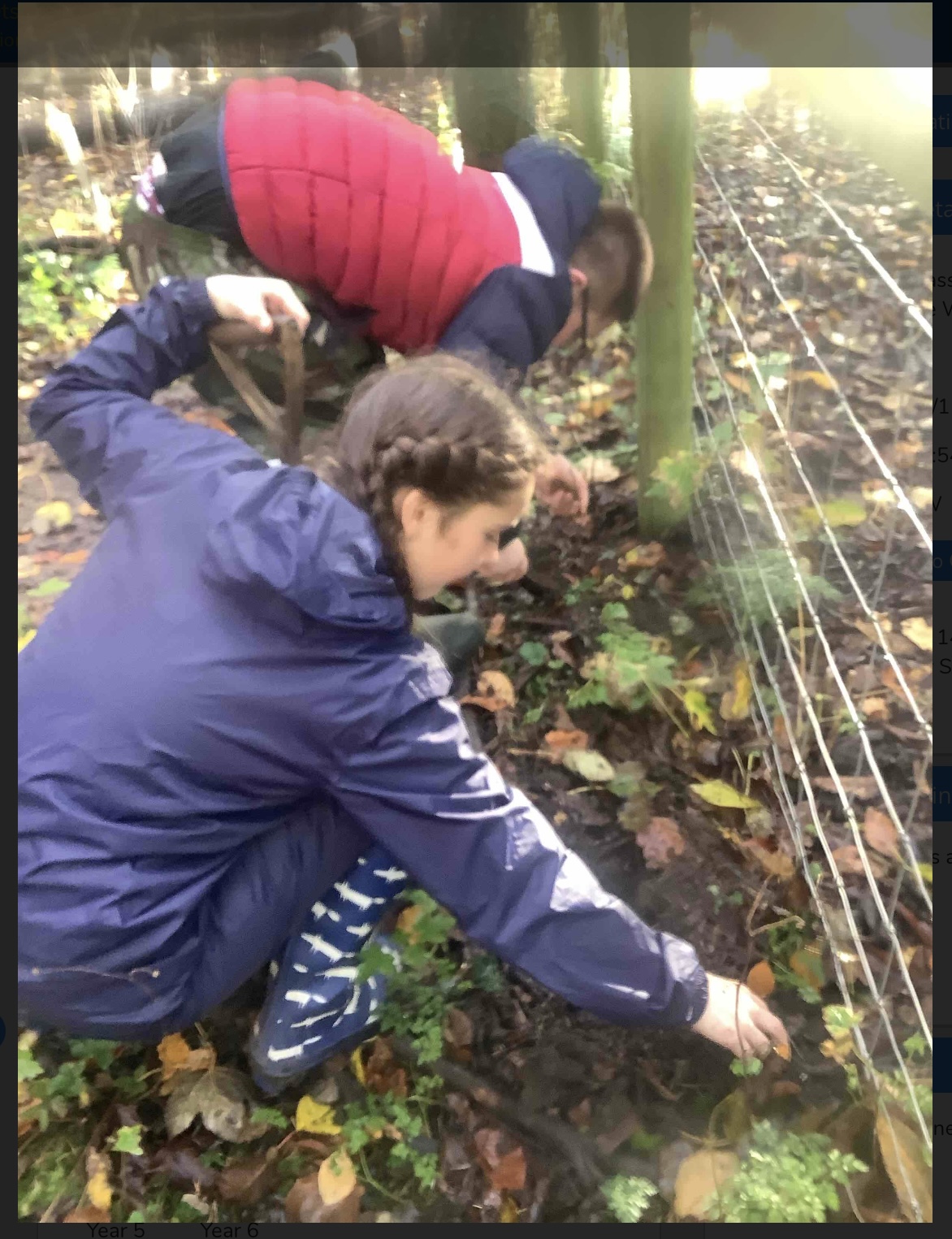
Forest school supports and enhances our PSHE curriculum
To enhance our PSHE curriculum, we allow the children to grow as citizens of the future through Votes for Schools. Votes for Schools is an online voting platform which engages learners to discuss issues affecting them. By voting, the children are able to let the world know what they think about current topics.
Because of our curriculum, St Mary's children are:
.PNG)